Jul. 23rd, 2006

vaneramos: (Default)

The insect I identified here a few weeks ago as a walking-stick was not, but instead a grass mantis, Thesprotia graminis. What's That Bug refers to it as a "southern species", and all online references associate it with Florida, but it was perched on my dock in Central Ontario on April 29, about three weeks after ice would have disappeared from the lake.

Here is another exquisite little mantid I spied while walking along the Speed River with Brenna, Mina and Barney on Friday afternoon. It was perched on this Eupatorium flower and I mistook it for some kind of sucking bug, but back home the macro images revealed its distinctive predatory foreleg. It's about 1 cm long.

We found some acrobatic little bugs scrambling around the branches of a spruce tree. They moved quickly and my photos didn't turn out. I figured they were feeding on buds or sap. Now I realize they were nymphs of the common European mantis or praying mantis, Mantis religiosa, so they must have been hunting other bugs.

There are about 20 mantis species found in North America, but I can't find a list of Canadian ones online. Does anyone know a source? I've written to What's That Bug in hope of identifying this one.

mantis 1


mantis 2

vaneramos: (Default)

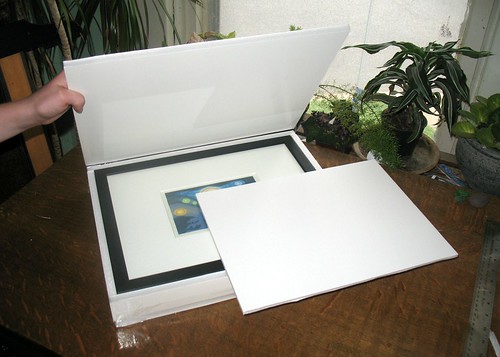
Chris Ahrens at Wyndham Art Supply used a diagram to show me how to construct foam boxes to protect my framed drawings for shipping. The boxes get stacked inside the parcel, and are durable enough to continue housing the artwork after the show is over.

For four drawings in 12" x 15" frames, I needed two 30" x 40" sheets of ½-inch foam board, and one sheet of ¼-inch. The thickness of this last sheet must match how deeply the glass is recessed inside the front surface of the frame. The foam board cost $35, about $9 per frame.

A box cutter or sharp knife with replaceable blades is essential for cutting. For each box, I cut one piece of ¼-inch to fit snugly in the front of the frame (that's the piece lying off to the right) to protect the glass. The bottom, sides and lid were cut from ½-inch board so the frame would fit snugly inside. The bottom and sides were assembled using white glue reinforced with packing tape around the corners and edges. The lid was hinged along one edge with tape so the box can easily be opened and reused. The glue adhered readily with the foam board, so I was able to work quickly and construct four boxes in less than an hour.

They can then be stacked, tied together with masking tape or string to stabilize the pile without tearing the foam board, encased in bubble wrap, and packed in a mailing box.


Profile

vaneramos: (Default)
vaneramos

August 2017

S M T W T F S
  12 345
6789101112
1314 151617 1819
20 21 22 23242526
2728293031  

Style Credit

Expand Cut Tags

No cut tags
Page generated Jan. 13th, 2026 07:00 am
Powered by Dreamwidth Studios