Oaks and cicadas
Aug. 2nd, 2006 09:43 pm![[personal profile]](https://www.dreamwidth.org/img/silk/identity/user.png) vaneramos
vaneramosOak savanna is one of North America's rarest habitats. Once covering 13 million hectares along the boundary between the prairies and eastern woodlands, it has been reduced to less than 0.02 per cent of its former area. Two-thirds of Pinery Provincial Park's 2,600 hectares are covered by a mixture of oak savanna and oak woodland. This is one of the largest surviving continuous tracts.
Black oak and eastern red cedar are two of the habitat's indicator species. The soil is dry and sandy. The woodland is relatively open, with bright sunlight penetrating to the ground, fostering a diversity of grassland plant species in the openings. Fires started by lightning are essential in keeping the savanna open.
In the 1950s little was known about oak savanna. Conservationists believed logging and wild fires had degraded the habitat. An aggressive rehabilitation program was undertaken. During the 1960s, three million red and white pine seedlings were planted at Pinery Provincial Park, and all forest fires were extinguished. These soon began shading out sun loving shrubs, grasses and herbs. The numerous microhabitats that characterize a savanna was reduced. A pine plantation has little biodiversity.
Recently, based on increased understanding of forest communities, many smaller pines have been removed.
Few species live only in oak savanna. What makes it so valuable is the extremely high species diversity. Plants and animals characteristic of both tallgrass prairie and Carolinian forest are represented here, as well as many like the Eastern bluebird that prefer an edge where two types of vegetation meet. Southwestern Ontario's native habitats feature the highest biodiversity of any region in Canada. Inhabiting some of the country's richest farmland, they are also severely threatened by agriculture. By far the greatest proportion of Canada's endangered species hail from Southwestern Ontario's native woodlands.
One sign of hope for oak savanna in Ontario is that some golf courses are establishing it in natural areas alongside fairways, presumably to compensate for their dismal environmental impact. Toronto's High Park also features a notable restored tract.
On my hike along Cedar Trail with Brenna on Friday, I saw a surprising number of new plant species: fragrant sumac, dwarf chinquapin oak (photo posted in ![[livejournal.com profile]](https://www.dreamwidth.org/img/external/lj-community.gif) iamthelorax), rough blazing star (a prairie wildflower). We also saw and heard an eastern towhee for the first time in many years.
iamthelorax), rough blazing star (a prairie wildflower). We also saw and heard an eastern towhee for the first time in many years.
One remarkable sound was the overlapping drones of an unfamiliar cicada. Pinery Provincial Park is home to a rare and little-known species, the scissor grinder cicada. In 1990 biologists discovered that the only previous record in Ontario came from Turkey Point in 1908. Danny and I heard some unusual cicadas there on our first date in August 2003. At first I thought these must be the rare scissor grinder. But doing an internet search yesterday I discovered the species has been extirpated from Turkey Point. Pinery is the only remaining site where it can be heard in Canada. Judging by sound files online, all the cicadas I heard in both places were different species. There seems to be a good number of native cicada species, which opens an interesting door of exploration.
All we saw was a piece of cicada carcass being dismantled by ants. In fact we saw armies of ants everywhere, unlike anything I've ever seen before. Thousands of them crossing the path, moving from place to place and back again. I even got bitten several times on the leg while trying to photograph some other insect.
The damselfly is Enellagma signatum, or orange bluet. The flower is wild bergamot, Monarda fistulosa, which holds a sentimental honour as the first wildflower I ever grew from seed. I was about 14 and had no idea what I had started until it bloomed. I've created a gallery of 13 images, mostly wildflowers and insects, taken in oak savanna at Pinery.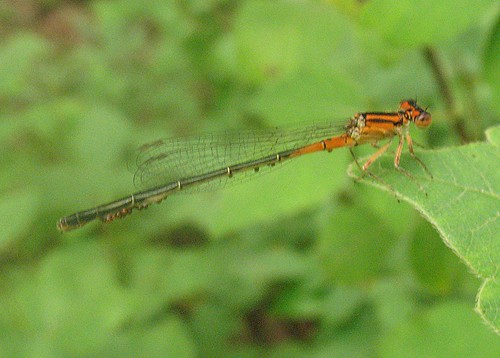


![[identity profile]](https://www.dreamwidth.org/img/silk/identity/openid.png)
no subject
Date: 2006-08-03 03:02 am (UTC)*I've seen the Blazing Star in one spot near peterborough (a tiny little cememtary that is preserved as both a historical site and a botanical one).
* I dated a guy who did his MSc from Guelph studying insect fauna at The Pinery
* I just took some (attempted) close-up shots of insects, actually just some honeybees and a colorado beetle (which I posted on flickr). Not quite as detailed as yours, but i'm slowly learning the technique. ;)
no subject
Date: 2006-08-03 04:31 pm (UTC)no subject
Date: 2006-08-04 03:16 am (UTC)I hope we can go out for a nature walk again sometime, except maybe not in the january cold ;) ....it's not often that I meet someone who is knowldegable about wild plants and things.
no subject
Date: 2006-08-08 11:03 pm (UTC)There have been lots of situations where I thought a tripod would help. I do have one, but haven't used it yet with the new camera. Sometimes the problem is the subjects themselves moving, especially in shade under trees where you can't use a fast shutter speed.