Singing Sands
Aug. 30th, 2006 11:48 pm![[personal profile]](https://www.dreamwidth.org/img/silk/identity/user.png) vaneramos
vaneramosWhile the eastern cliffs of Bruce Peninsula National Park must offer one of the most spectacular freshwater shorelines in the world, there is something magical about Singing Sands, on the western shore, that keeps drawing us back. Apparently the sands around Dorcas Bay actually used to sing. They do no longer, but plenty of enchantment remains for naturalists and children of every age.
The first time I visited this part of the park was on August 31, 1997, with Dan, my partner at the time. We would not find out about the princess's death until later, returning to our campground to find it abuzz with the news. That afternoon we walked in awe. Dan was an amateur geologist. So was I, but on that first visit it was the wildflowers that drew my attention. I had never seen most of them before: grass-of-Parnassus, fringed gentian, lady's-tresses, brook lobelia, horned bladderwort, Gerardia, harebell, a variety of unfamiliar asters and goldenrods. I hadn't taken a field guide with me and didn't know most of them. That first visit I prodded through the beach grasses gasping in surprise at how much I had to learn from such a small tract of land. Meanwhile he made similar exclamations about the rock formations.
As mentioned in yesterday's post, the limestone bedrock on this side of the peninsula slants so gradually that it is virtually flat. In some places around Dorcas Bay the rocks are striated with long, rounded furrows from the flow of glaciers, as if a giant plough had pushed its way across the surface. Nearby, the rock is flat as weathered pavement, pock-marked with erosion by rain and small surface gravel.
There is the alvar. In late summer most of the vegetation has fallen dormant due to lack of moisture, but the stalks and seed pods of wild iris indicate it was water-logged in spring. This is one of the last few habitats on earth where one is likely to find a Massasauga rattlesnake, which likes the warm rocks in summer. These are of course venomous, but shy and unlikely to bite. We have never seen or heard one.
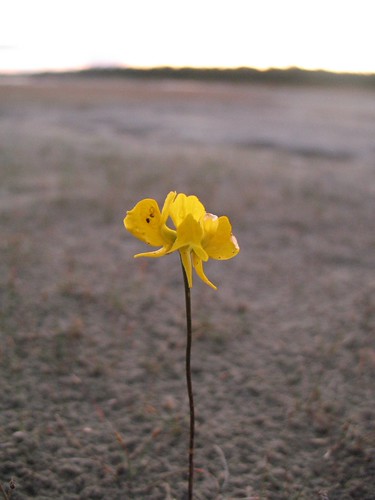
The bay itself is as shallow as a wading pool out to a great distance, and an extremely wide sand beach has formed in its shelter. This beach does not seem particularly popular, perhaps because it is so flat and the sand is invariably damp, as if at low tide, but no tides wash this swath. As Marian pointed out last week, the beach is furry. Where foot traffic is light enough, the sand is covered with tiny leaf blades. They look like sedges, but in some places they bloom with tiny, innocuous pale purple sprigs. Suddenly in the midst of desolation will arise an occasional horned bladderwort, completely alien: small, bright yellow flower cluster atop a straight stalk, utterly leafless, but in fact the leaves are buried below.
Behind the beach is a fen, a wet meadow, populated with pitcher-plants and orchids. The first time we visited Singing Sands, we watched three water snakes in the adjoining stream.
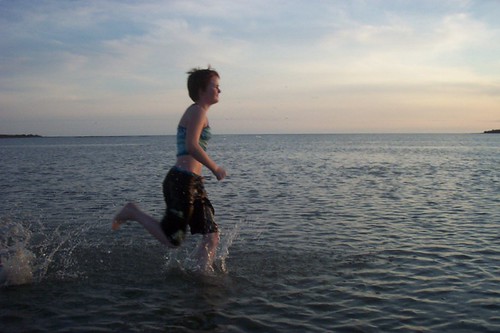
When the girls were younger we would spend hours building sand castles in the wet sand. Or when a warm summer breeze blew off Lake Huron, we would spend all afternoon body surfing on the clear waves of the bay, sunlight rippling across grey sand just beneath the surface. This year we visited Singing Sands twice, both times limited by the draining-away of daylight. The girls were mostly content to explore the rock and sand beaches in search of crayfish, frogs and other creatures. Marian found the delicate jawbone of what I took to be a small deer. Brenna and I did manage to go swimming the second evening at dusk. We had to wade out forever to reach water past our waists.
Our second visit fell on our last night in the park, and I exhausted the 1 GB memory card in my new Canon. Anticipating this, I had also taken the Kodak DX3500 on the trip. I ended up using the old camera for some of my photos at Singing Sands. It was a surprising experience; my way of seeing things has changed subtly with the new camera. I dared to take macro photos of flowers with the Kodak, something I rarely attempted because the view screen is practically invisible in outdoor light, and those photos did not turn out after all. But despite the Kodak's low resolution and lack of capacity for adjusting exposure, I am impressed with the way it photographs natural light and landscapes. I've spent several evenings this summer photographing sunsets with the Canon A620, manipulating aperture and shutter speed to my endless delight, and with satisfying results, yet I notice a certain ethereal quality peculiar to twilight images captured with the point-and-shoot Kodak.
The first two photographs in this series were taken at Singing Sands the Tuesday night we arrived, August 22, using the Canon, and I could not have taken such pictures with the Kodak. The wildflower is horned bladderwort, Utricularia cornuta. The other three were taken on Thursday evening using the Kodak, and with the Canon they would not have been the same.
No doubt I'll take these cameras and other future ones back to Singing Sands. It remains to me one of the most fascinating places I've ever visited.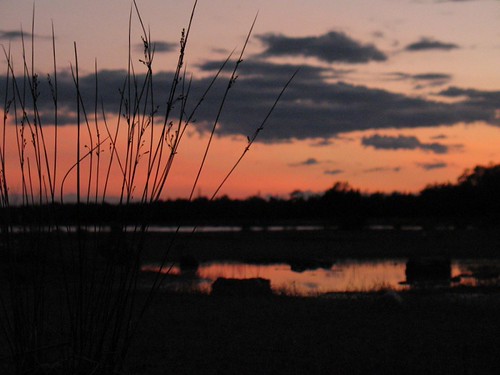


![[identity profile]](https://www.dreamwidth.org/img/silk/identity/openid.png)
no subject
Date: 2006-08-31 05:40 am (UTC)Lovely images.
no subject
Date: 2006-08-31 11:52 am (UTC)no subject
Date: 2006-08-31 01:52 pm (UTC)We install the Google Earth program on public machines here in the Math Department and I realized this morning, with a shock, that I would probably follow your narrative better if I booted it up and told it to find the Bruce Peninsula for me. Something about maps helps me to visualize. A few moments later I had my view, from a supposed altitude of 67 miles. A great aid to my concentration! Somehow, it helped me focus in on your words, breaking away here and there to look at the map and think about what you were telling me. Which you tell beautifully.
The Flickr photo set is absolutely gorgeous. Such beautiful flora and fauna, and such landscapes.
Thank you.
no subject
Date: 2006-08-31 02:19 pm (UTC)Cheers,
Van
no subject
Date: 2006-08-31 02:20 pm (UTC)no subject
Date: 2006-08-31 02:38 pm (UTC)It's exciting for me to be writing in this vein after a few years not having the concentration or will for it. I'm not sure why that happened, although I felt burned and exploited by the way Suite101 deteriorated. But nature essays are one of my things, so it's encouraging that you enjoyed these so much, Pete.
no subject
Date: 2006-08-31 03:02 pm (UTC)The Raymo/Raymo book is also quite wonderful. Chet Raymo writes science articles here in New England, see http://www.sciencemusings.com/. Maureen is a scientist, she works with Woods Hole and teaches at Boston University http://www.maureenraymo.com/
I think you would enjoy both books.
Nature writing takes concentration to write, and also to read. As you've been doing more of it, I've been schooling myself to make sure I read the posts when I can give them time and thought, and not let myself get distracted by the million bells and whistles that either call for my attention, or that I am thinking of already. I don't want to miss it; it takes a different kind of attention than most of my LJ reading, or even your posts which talk more directly about human beings ... though your nature posts always have a strong connection to YOUR human interests. :)
no subject
Date: 2006-08-31 03:21 pm (UTC)*relaxes*
no subject
Date: 2006-08-31 03:26 pm (UTC)no subject
Date: 2006-08-31 03:44 pm (UTC)no subject
Date: 2006-08-31 03:44 pm (UTC)no subject
Date: 2006-09-02 05:50 am (UTC)no subject
Date: 2006-09-03 09:00 pm (UTC)