Eramosa revitalized
Feb. 22nd, 2006 05:08 pm![[personal profile]](https://www.dreamwidth.org/img/silk/identity/user.png) vaneramos
vaneramos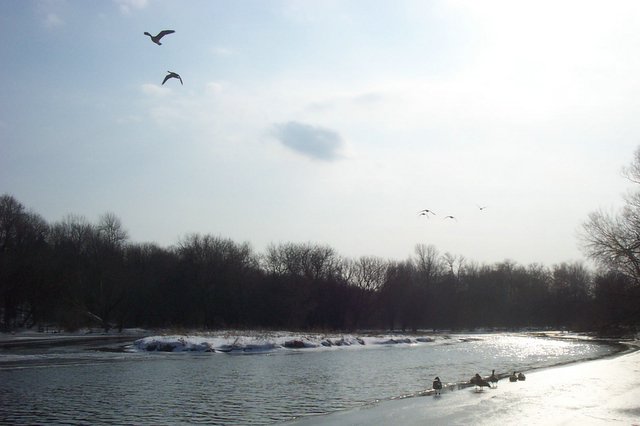
Canada geese along the Eramosa River
Roy is an older gentleman who attends potluck lunches at Two Rivers every Wednesday. He has lived here all his life. He told me the bank of Eramosa River where the park runs used to be a dump. I had suspected as much. The ground, now covered with mature trees, has an uneasy quality as if laid down to cover something up.
When I was growing up on Lake Erie, my parents bought an adjoining vacant lot to prevent developers from getting ahold of it. The golf course behind had a right-of-way allowing irrigation from the lake. But the farmers who owned the land before used the bluff as a dump. We dumped rock to prevent erosion in the 1970s, but before that garbage still lay exposed. We neighbourhood children would sift through it for treasures, better than household trash.
Before the Cuyahoga River fire in 1969, people dumped everything into the Great Lakes. Humans everywhere traditionally expect watercourses to wash away the stains of society. This attitude requires considerable political will to change.
It's hard to quantify the pleasure I derive from a sliver of riparian land that once served as Guelph's junk heap. This journal is a tribute.
~~~~~~~~~~~
Another photo is posted in
![[livejournal.com profile]](https://www.dreamwidth.org/img/external/lj-community.gif) texture.
texture.


![[identity profile]](https://www.dreamwidth.org/img/silk/identity/openid.png)
no subject
Date: 2006-02-23 12:28 am (UTC)no subject
Date: 2006-02-23 04:02 am (UTC)no subject
Date: 2006-02-23 03:34 am (UTC)no subject
Date: 2006-02-23 04:12 am (UTC)Ontario's rivers are much more interesting than they seem. At the pearl exhibit at ROM a while back, there was a section focusing on freshwater oysters in Ontario. Eastern North America has the world's greatest species diversity in this group, but many of them are of course endangered. Most of the world's seed pearls come from this area, so there is economic value in conserving their habitats and diversity. There is a program underway reintroducing several endangered native oyster species to sections of the Thames River and nearby waterways.