Landscape of the Bruce
Aug. 29th, 2006 10:00 pm![[personal profile]](https://www.dreamwidth.org/img/silk/identity/user.png) vaneramos
vaneramosSouthwestern Ontario has many regions of botanical and ecological interest, but Bruce Peninsula is one of the most exceptional; home to 44 orchid species and more than 20 fern, it contains a wide diversity of habitats. This is partly due to the peninsula's peculiar geology.
460 million years ago North America and Europe collided, giving rise to a range of mountains in the Northeastern part of the continent. These gradually eroded, their sediments settling westward to the bottom of a sea populated with trilobites, crinoids, shellfish and corals. These formed a wide limestone plate known as the Michigan Basin. The basin itself has in turn eroded. However the rock strata are slightly inclined downward to the middle, and underlying layers are softer, so the basin eroded much faster around the edges, giving rise to the Niagara Escarpment. This long cuesta, cut and divided by successive periods of glaciation, runs from New York state through Ontario, Michigan, Wisconsin and Illinois. It cuts southeast and northwest across Lake Huron, forming Bruce Peninsula, Manitoulin Island and an archipelago of smaller islands alongside.
The escarpment itself forms the peninsula's eastern shore, falling sharply into Georgian Bay. These cliffs rise as high as 60 metres and plunge as deep as 90 metres below the water. The water there is uncommonly pure and clear, free of pollution and plankton. By contrast on the west shore, the land slopes gently toward distant Michigan giving rise to wide beaches, fens, dunes and one of the rarest habitats of all: alvars.
Found only in Estonia, Sweden and the Great Lakes Basin, alvars occur on flat layers of limestone bedrock barely covered with topsoil. With little root protection, native organisms are subject to freezing in winter, flooding in spring, and drought in summer. Only plants specially adapted to these conditions can survive. One-third of plant species growing in the Dorcas Bay alvar are provincially rare.
In fact the last glacial age left little topsoil anywhere on Bruce Peninsula. The farmland is marginal, suitable for cattle but little else. Partly for this reason, the region harbours a large percentage of surviving forest in Southwestern Ontario.
The most interesting trees of all live on the face of the escarpment itself. Eastern white cedars will grow practically anywhere, but on the cliff face they are protected from forest fires. Deriving scarce nourishment from clefts in the rock, they grow exceedingly slowly and live exceptionally long lives, frequently for hundreds of years.
The remains of a dead cedar were recently found at the bottom of a cliff on Flowerpot Island. Dendrochronology determined it had lived more than 1,800 years, making it the oldest tree ever identified in eastern North America. Not only that, carbon dating showed it had lain at the bottom of the cliff without rotting for centuries.
The entire Niagara Escarpment is an important and sensitive part of our natural heritage. In 1990, UNESCO designated the Ontario segment a World Biosphere Reserve. The Bruce Peninsula affords some of the escarpment's most spectacular geological formations and well-preserved habitats.
I camped there for the first time in 1987, at Cyprus Lake Provincial Park. In 1990 it became part of Bruce Peninsula National Park. The adjoining Fathom Five National Marine Park, containing underwater cliffs and 22 shipwrecks, is considered the best scuba diving location in Canada.
I would love to learn to dive, but regardless I will continue to return to the region as often as possible to enjoy the unusual wildflowers and rugged landscape. It so happens the five or six times I've visited have all been in late August or early September. I hope to make my next pilgrimage during a different season, perhaps early summer, to see different wildflowers, perhaps more of those famous orchids.
I'll post more photos of wildflowers later. For now, here are some of the geological characteristics of the Niagara Escarpment. Marian found the fossil coral in 460-million-year-old Silurian dolostone along a rocky Georgian Bay beach. Ice and water had apparently eroded the softer surrounding rock, exposing tiny creatures of the ancient sea. This one is about 3 mm thick.
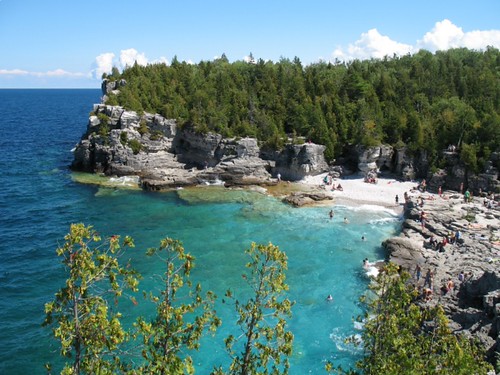
Next is a shot of Indian Head Cove, a popular swimming spot in the national park, but you have to hike half an hour over rugged terrain from Cyprus Lake campground to reach it. The water is chilly but oh, so clear and refreshing. The cliff is typical of the peninsula's eastern shoreline.


![[identity profile]](https://www.dreamwidth.org/img/silk/identity/openid.png)
no subject
Date: 2006-08-30 02:14 am (UTC)no subject
Date: 2006-08-30 02:24 am (UTC)no subject
Date: 2006-08-30 02:26 am (UTC)no subject
Date: 2006-08-30 11:49 am (UTC)no subject
Date: 2006-08-30 02:27 pm (UTC)no subject
Date: 2006-08-30 02:36 pm (UTC)no subject
Date: 2006-08-30 02:51 pm (UTC)I've seen many artists' studios and shops around the peninsula, but haven't had any opportunity to explore them. I hope to spend more liesurely time there someday (the girls keep me hopping!).